
In 1974, Australian Iron and Steel (AIS) Collieries commenced clearing of the site to open a new colliery to access its coal lease areas to the west of the escarpment. The Cordeaux Colliery site is located adjacent to the Picton Road, approximately 21 km by road from Wollongong.
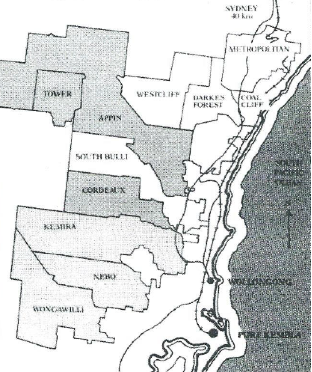
Of necessity, the mine site was located in the water catchment area of the Cordeaux Dam which is under the control of the Metropolitan Water, Sewerage and Drainage Board (MWSDB).[1] Strict conditions were imposed on the development of the mine site and its later operation as a producing coal mine. The mine was the first coal mine established within the catchment area.
The conditions of approval restricted the mine site to a very small surface area. All run-off water from the site is contained by a “three dam water filtration system” constructed on site for the purpose of ensuring that only clear clean water is discharged from the site. A sewage treatment plant was installed to treat bath-house water and other waste water. Treated water from the sewage treatment plant is pumped off the mine site, and out of the water catchment area, and delivered by an overland pipeline to Wilton where the discharged water was used for spray irrigation of pastures on a privately owned farmland property in that area. All mine water was treated and recycled for use underground and all machinery to be taken away from the site was washed down underground.
The colliery was designed to be a two shaft mine. One shaft was utilised as a downcast (intake airflow) shaft and fitted with a personnel and materials winder with the capacity to transport 180 people at a time. The second shaft was an upcast shaft, with a mine ventilation fan on the surface, and this shaft was fitted with a bulk coal winder to transport coal out of the mine. Both shafts were concrete lined with an internal diameter of 7.5 m for the personnel and materials shaft and 6.1 m for the bulk coal winder shaft. At that location, the Bulli coal seam is at a depth of 432 metres from the surface and the Wongawilli coal seam is at a depth of 474 metres.
Electricity was supplied to the site by a 33kV overhead transmission line to the mine from the existing AIS Collieries 33 kV overhead transmission line system located on the escarpment that was sourced from the AIS Port Kembla steelworks. A permanent electricity substation was erected on the mine site.
Clearing of the site, erection of the shaft sinking headframe and support facilities enabled the sinking of the No.1 Shaft to commence in October 1974.
Both shafts were sunk by Allied Constructions. During the sinking of both of these shafts, construction commenced on the erection of the permanent mine winder headframes around the perimeter of the sinking headframe structures in use by Allied Constructions.
Allied Constructions was also contracted to excavate the underground coal storage bin and related hard rock work at the base of the shafts.
The sinking of both shafts was completed in 1978.[2]Surface buildings were constructed including the bath-house, administration office, workshop and store which were completed in January 1980. A feature of this colliery is that it did not have a coal stockpile.[3]
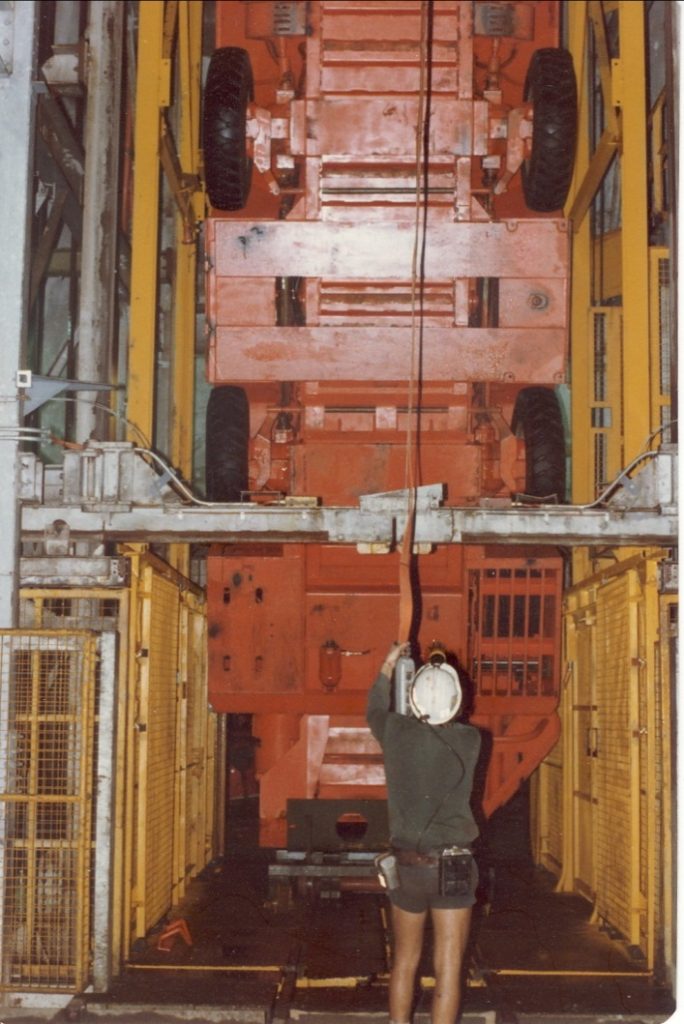
The personnel and materials winder was commissioned on 14th March 1979. On the same day a continuous miner and a shuttle car were lowered into the mine and were cutting coal two days later.[4]
The haulage system to bring coal out of the colliery via one shaft, called a bulk coal winder, was rated originally at 600 tonnes per hour. This winder was commissioned in July 1980. On the surface, the coal was then loaded on to an enclosed conveyor and transported to two coal storage bins of 1,500 tonnes capacity.[5]
At these bins the coal was loaded into road trucks which transported the coal along Picton Road and the upper section of Mount Keira Road, to the O’Brien’s Drift Dumping Station. O’Brien’s Drift is a sloping tunnel excavated through the mountain. A decline belt conveyor installed in the Drift discharged the coal into an “over-rail” coal storage bin located in the Kemira Valley adjacent to the Kemira coal handling plant. There the coal was loaded into wagons for haulage by train to the Port Kembla Steelworks.
Ventilation of the mine was provided by two parallel single inlet centrifugal fans with the capacity to circulate 250 cubic metres of air per second through the mine. Being a shaft mine, a Rolls Royce generator package was installed to provide electricity for emergency ventilation and fire fighting in case of power loss.
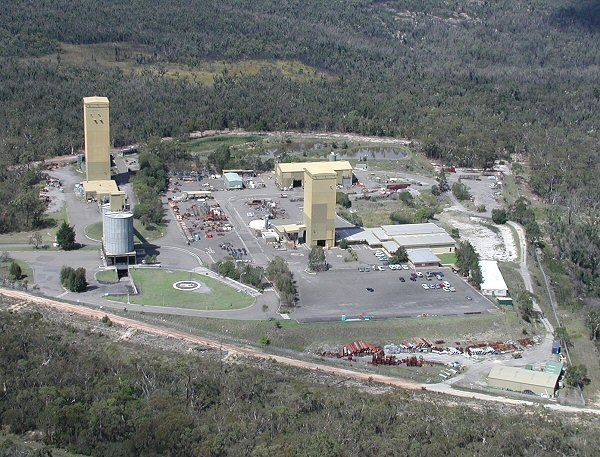
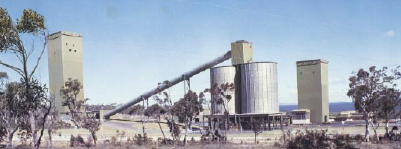
The mine was developed at a cost of $34 million and additional capital expenditure of $62 million dollars was expended by 1998.[1] On 16th March 1979 the first coal was produced from the mine and in 1980 the mine was officially opened by the NSW Minister for Mines, Mr R Mulock.
At the commencement of mining operations, the coal mined was loaded into 10 tonne capacity mine cars and hauled by battery locomotive to the pit bottom to be hoisted to the surface via the personnel and materials shaft while the bulk coal winding system was being installed and commissioned in the upcast shaft. Following the commissioning of the bulk coal winder, conveyor belts were installed to convey the coal from the working faces to the pit bottom area. There the coal was crushed and screened and stored in the underground storage bins and hauled, to the surface by the fully automatic bulk coal winder.
Cordeaux Colliery was the first mine in the southern coalfield to use W-irons (W-straps) and roof-bolts as its sole method of roof support system as opposed to the more conventional timber props and roof bars.[1] The mine was developed with four continuous miner units used to drive the main underground roadways and eventually form longwall blocks ready for extraction.
During the 1980/81 period, a review of the AIS Collieries was undertaken and this led to the decision to merge Cordeaux Colliery with Corrimal Colliery. There were retrenchments at Cordeaux Colliery in January 1982 and March 1983 due to a downturn in the industry. The first ‘’holing’’ of the mine’s workings between the Corrimal and Cordeaux took place in November 1985 and the Corrimal Colliery was officially declared closed in December 1985.
Many of the Corrimal Colliery employees transferred to Cordeaux Colliery in January 1986, as a result of the merging of the two collieries, and this boosted the workforce of the colliery to 325 employees. From that point onwards, Cordeaux Colliery became a longwall mine.[2]
Following the merging of the two mines, the mining of the Longwall 10 section in the Corrimal lease area continued with the coal being wound to the surface via the Corrimal No.3 Shaft bulk coal winder until that Longwall section was extracted. From Longwall 11 onwards coal was wound to the surface via the Cordeaux Colliery bulk coal winder.
The Corrimal No.3 Shaft was initially utilised as a downcast (intake airflow) ventilation shaft to complement the ventilation of the Cordeaux Colliery and in 1992 the No.3 Shaft was converted from downcast ventilation to upcast shaft duties when a redundant Kemira Colliery Aerex type centrifugal fan was installed on the shaft.
The winding capacity of the bulk coal winder was upgraded from 600 to 700 tonnes per hour in 1993, [3] with the production from the mine having increased from 60,000 tonnes per annum in 1980 to about 2.8 million tonnes in 1993, and the workforce to 360 employees.[4] At this point in time the Cordeaux Colliery was supplying more than one third of the coking coal needed by the Port Kembla steelworks.
At various times the Cordeaux Colliery was the highest producing longwall mine in Australia, achieving this record for the first time in 1991, and was the first colliery in Australia to have successfully mined a longwall block 3.2 kilometres in length.[5] During the late 1980s and early 1990s the mine was consistently the highest producing underground coal mine in Australia.
The width of the longwall face was increased from 150 m to 200 m by utilising 33 refurbished longwall chocks from the Corrimal Colliery.[6] This increased the efficiency of the mine operations as more longwall tonnes were being accessed per metre of each development roadway being driven.
The colliery management trialled several different types of mining equipment in an attempt to improve roadway development rates.
In 1987 the Paurat Miner, a full-face mining machine with on-board roof-bolting rigs, was introduced. Whilst 1,260 metres of roadways was driven it was withdrawn, as it failed to demonstrate an improved performance over the existing equipment used for this purpose.
A Kloeckner Becorit floor mounted mobile conveyor system, was trialled as a possible replacement for the shuttle car, and was found to be unsuccessful and withdrawn. In 1997 an ABM20 mining machine was trialled with mixed results, and was withdrawn.
The highest annual production from the mine was achieved in the 1993-94 financial year with 2,965,429 tonnes produced. By 1998, the total production from the mine was 30 million tonnes and 262 km of development roadways had been driven.[7]
From its outset, Cordeaux Colliery had developed an excellent safety culture and demonstrated “that high productivity goes hand in hand with better safety”. This resulted in Cordeaux Colliery becoming the first and only BHP site to receive the NSW Minerals Council Gold Award for Safety in 1997.[8] Also, it was the first underground mine in Australia to receive Quality Accreditation to Australian Standards AS3902.[9]
The name of the company operating the mine changed from Australian Iron and Steel (AI&S) Collieries to “Illawarra Coal” a division of BHP Billiton in 1994 and, in 1999, 67 employees were laid off pending the closure of the Newcastle steelworks by BHPBilliton.[10]
Bulli Seam Mining
The mine worked the Bulli seam extensively. At Cordeaux Colliery this coal seam was at a depth of between 400 m and 500 m below the surface and the seam thickness varied between 1.8 m and 2.8 m.[11]
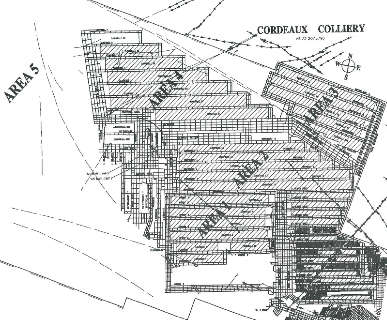
The plan of the mine below shows the Areas 1 to 5 which were mined in numerical order. Area 1 was in the original Corrimal Colliery lease, and it was decided to abandon this are due to decreasing coal quality and the occurrence of major faulting in the middle of the planned longwall blocks. Whilst Longwall 11 was extracted up to the fault, Area 4 encountered increasing gas content which slowed development roadway advance rates, and some of the longwall blocks were shortened due to a fault/dyke system in the seam.
Area 5 was found to have coal quality issues with approximately 25% of the area having a high ash content, and the thickness of the seam had reduced to minus 1.8 metres, a dimension unsuited to the existing longwall roof supports, suggesting a need to purchase replacement longwall equipment to mine the area. A major upthrow fault of 30 m was also known to be present along with a high level of carbon dioxide (CO2) gas in the seam that could require the installation gas drainage procedures, plant and equipment.
These factors led to the company announcing in October 1997, that the Cordeaux Colliery would be downsized due the depletion of quality coal reserves in the Bulli Seam.
[1] BHP Coal “Cordeaux Colliery – The Story So Far” 1998, p. 40
[2] BHP Coal “Cordeaux Colliery – The Story So Far” 1998, p. 40
[3] BHP Coal “Cordeaux Colliery – The Story So Far” 1998, p. 67
[4] BHP Steel, Collieries Division “The Collieries Handbook” December 1993, p. 28
[5] BHP Steel, Collieries Division “The Collieries Handbook” December 1993, pp. 28, 30
[6] BHP Coal “Cordeaux Colliery – The Story So Far” 1998, p. 43
[7] BHP Coal “Cordeaux Colliery – The Story So Far” 1998, p. 91 and p. 92
[8] BHP Coal “Cordeaux Colliery – The Story So Far” 1998, p. 58
[9] BHP Coal “Cordeaux Colliery – The Story So Far” 1998, p. 5
[10] B J Andrews “Coal Mines of New South Wales” published by Coal Services, 2011, p. 120
[11] BHP Steel, Collieries Division “The Collieries Handbook” December 1993, p. 31
Wongawilli Seam Mining
In 1995 plans were developed to mine the Wongawilli coal seam, the third seam in the Illawarra Coal Measures and known as the No.3 Seam. Access drifts and ventilation staple shafts were driven underground from the Bulli seam down to the No.3 Seam workings.
To enable the development of longwall blocks greater than three kilometres in length, access to the Wongawilli seam was made from both pit bottom and at the far end of the mine. Access to the seam near the pit bottom area was by a 1 in 20 drift for transport, along with a 1 in 7 drift for a conveyor belt haulage along with and four raise bores of 1.5 m diameter to provide upcast ventilation. At the far end of the mine, access was provided by a 1 in 20 drift for transport, a 1 in 7 drift for a conveyor belt haulage with plans to have four raise bores of 1.5 m diameter for ventilation, however, these raise bores were never driven.
The gas content of the seam was found to be greater than that found in the Bulli seam, however, a simple gas drainage system was designed to reduce the seam gas content to an acceptable level, without the need for a surface gas extraction plant. Although 2,982 metres of development roadways were driven in the seam, a decision was made in December 1997 to abandon the further working of the Wongawilli seam in December 1997.
Outburst Prevention
Cordeaux Colliery had a lower seam gas content than other deep mines working the Bulli coal seam and did not experience a gas “outburst” at the colliery. The gas content in the Bulli seam at the mine was typically below 9 cubic metres of gas per tonne of coal and the composition of that gas was predominantly methane.[1]
Prior to 1991, underground drilling at this mine had been confined to exploration drilling of the coal seams by contractors. The occurrence of a triple fatality due to a gas outburst at South Bulli Colliery in 1991 prompted most collieries in the southern coalfield to develop their own Outburst Management Plan (OMP). The original OMP at Cordeaux Colliery was developed and instigated in late 1991.
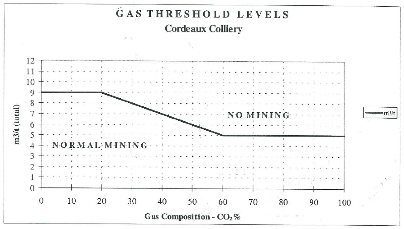
One of the impacts on Cordeaux Colliery was that an “upper allowable limit” for seam gas content was set at 9 cubic metres per tonne. Additionally the mine had to drill ahead of the working faces and core the coal seam to determine the seam gas content at that location before mining proceeded. The graph depicts that the allowable limit for mining decreases to 5 cubic metres per tonne with increasing carbon dioxide in the seam gas.
The first drill rig used to drill ahead of the working faces and core the coal seam was a single motor ProRam drilling rig that was compressed air operated and used drill rods that were only 1.5 m long. In September 1992, a RamTrak was purchased. It is a twin motor, crawler track mounted ProRam with a “through the chuck” operation allowing longer drill rods to be used. This was far more efficient than the original “stinger mounted” ProRam drilling rig.
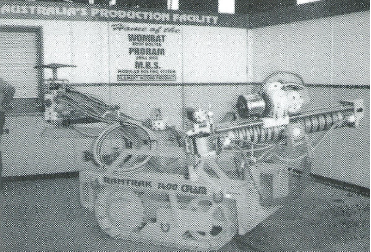
A second RamTrak was purchased in September 1993 and the third RamTrak was purchased in July 1995. This fleet of three drill rigs was sufficient to drill and core ahead of the coal faces for outburst prevention.[1]
Over 120 km of drilling was conducted in the first six years after drilling was introduced. A fourth drill rig, a stinger mounted ProRam, was utilised for exploration drilling of the Wongawilli coal seam from the Bulli seam workings. An Eastman single shot borehole camera was purchased in September 1995 and routine surveying of all boreholes was introduced as standard practice on completion of each borehole.
Usually, gas drainage of the Bulli seam was not required as the seam gas content was usually below the outburst threshold of 9 cubic metres of gas per tonne of coal. Where gas content above the threshold limit did prevent mining, the area was allowed to degas naturally with the assistance of multiple holes drilled ahead in the seam.
The Wongawilli coal seam had a higher seam gas content than the Bulli seam and the volume of gas released at the coal face was relatively high. Boreholes drilled into the Wongawilli coal seam from the overlying Bulli seam workings assisted in relieving gas from the Wongawilli seam and there was rarely a need for gas drainage. One example where simple gas drainage was utilised was in Vickery panel where seam gas from boreholes in the face area was piped along the return roadways to a raise bore into the Bulli seam return airways. This method of gas drainage eliminated the need to install a surface gas extraction plant complete with vacuum pumps, to assist the extraction of seam gas at the colliery.
Mine Closure
In 1998 the mine was downsized due to the depletion of the Bulli seam coal reserves and the remaining longwall blocks in the Bulli seam were extracted. Production ceased in March 2001 with Cordeaux Colliery having produced a total of more than 26 million tonnes of coal.
In 2003 Cordeaux Colliery was officially closed and placed on care and maintenance. The ventilation fan on No.3 Shaft was shut down and the two shafts on the mine site were capped. The No.3 Shaft winder structure remains standing, with the major components of the bulk skiphoist transferred to other mines in the group as spares.
In 2005 the mine ventilation fan and associated items installed at the abandoned Corrimal No.2 Shaft were removed, the shaft backfilled, capped with concrete and the surrounding area rehabilitated. The Corrimal Colliery No.1 Shaft was capped with concrete and the original mine entry portals to Corrimal Colliery were sealed.
The Cordeaux Colliery mine site continues to be utilised by providing office facilities for many of the technical staff employed in the GM3 mining company.
[1] BHP Coal “Cordeaux Colliery – The Story So Far” 1998, p. 4
[1] The former Metropolitan Water, Sewerage and Drainage Board is now known as Sydney Water
[1] B J Andrews “Coal Mines of New South Wales” published by Coal Services, 2011, p. 120
[1] BHP Coal “Cordeaux Colliery – The Story So Far” 1998, p. 38
[1] BHP Coal “Cordeaux Colliery – The Story So Far” 1998, p. 39
[1] BHP Steel, Collieries Division “The Collieries Handbook” December 1993, p. 30
[1] Photo source: Cordeaux Colliery archival records
[1] Photo source: Cordeaux Colliery archival records
[1] BHP Steel, Collieries Division “The Collieries Handbook” December 1993, p. 28 and p. 92
[1] Photo source: Cordeaux Colliery archival records. The shuttle car is lowered vertically to fit in the cage
[1] BHP Coal “Cordeaux Colliery – The Story So Far” 1998, p. 40
[1] BHP Coal “Cordeaux Colliery – The Story So Far” 1998, p. 40
[1] BHP Coal “Cordeaux Colliery – The Story So Far” 1998, p. 67
[1] BHP Steel, Collieries Division “The Collieries Handbook” December 1993, p. 28
[1] BHP Steel, Collieries Division “The Collieries Handbook” December 1993, pp. 28, 30
[1] BHP Coal “Cordeaux Colliery – The Story So Far” 1998, p. 43
[1] BHP Coal “Cordeaux Colliery – The Story So Far” 1998, p. 91 and p. 92
[1] BHP Coal “Cordeaux Colliery – The Story So Far” 1998, p. 58
[1] BHP Coal “Cordeaux Colliery – The Story So Far” 1998, p. 5
[1] B J Andrews “Coal Mines of New South Wales” published by Coal Services, 2011, p. 120
[1] BHP Steel, Collieries Division “The Collieries Handbook” December 1993, p. 31
[1] BHP Coal “Cordeaux Colliery – The Story So Far” 1998, plan dated May 1998, p. 50
[1] Brian Sheldon “Cordeaux Colliery – The Story So Far” 1998, p. 82
[1] BHP Steel, Collieries Division “The Collieries Handbook” December 1993, p. 83
[1] Photo source: BHP Steel, Collieries Division “The Collieries Handbook” December 1993, p. 118 [1] Brian Sheldon “Cordeaux Colliery – The Story So Far” 1998, p. 81